

FSSC 22000 Lead Auditor Training: Complete Guide for Food Safety Professionals in 2026
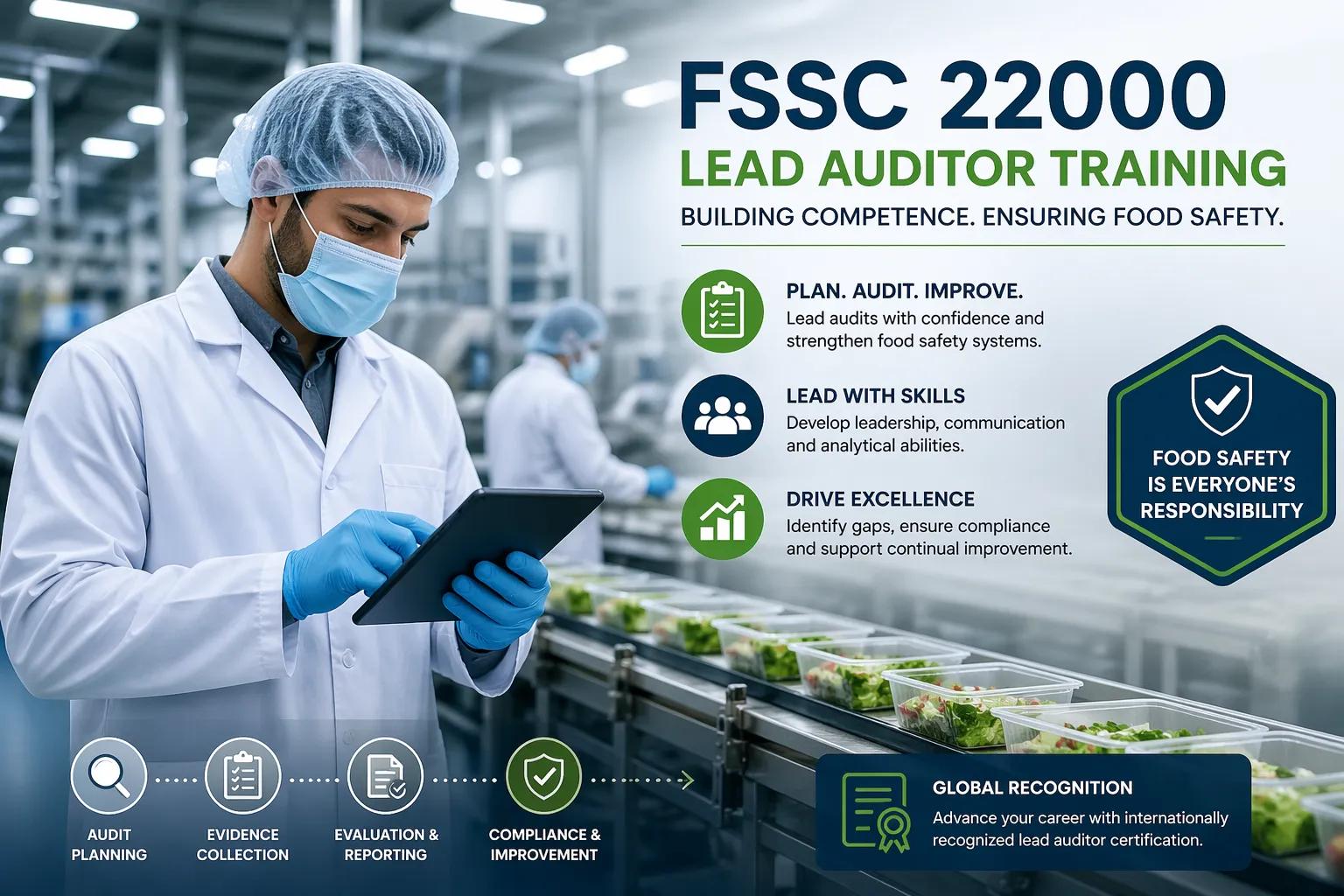
FSSC 22000 Lead Auditor Training
Introduction
Food safety has become a strategic priority for manufacturers, processors, packaging companies, storage providers, retailers, and other organizations operating across the global food chain. Customers and retailers increasingly expect suppliers to demonstrate robust food safety controls and internationally recognized management systems.
FSSC 22000 lead auditor training is designed for professionals who want to develop advanced skills for planning, conducting, reporting, and following up food safety management system audits. FSSC 22000 combines ISO 22000 with sector-specific prerequisite programmes and FSSC Scheme requirements.
For food safety managers, quality professionals, consultants, auditors, HACCP team members, and technical personnel, this training can provide valuable knowledge for evaluating food safety systems and identifying opportunities for improvement.
The training landscape is also evolving. In May 2026, the Foundation FSSC published FSSC 22000 Scheme Version 7, making awareness of current scheme requirements especially important for professionals planning auditor development.
1. What Is FSSC 22000 Lead Auditor Training?
FSSC 22000 lead auditor training is an advanced auditing program that teaches participants how to evaluate food safety management systems against applicable FSSC 22000 requirements.
The course typically builds knowledge in areas such as:
ISO 22000 requirements
Sector-specific prerequisite programmes
FSSC 22000 Scheme requirements
HACCP principles
Food safety hazard identification
Audit planning and preparation
Objective evidence collection
Interviewing techniques
Audit-team management
Nonconformity identification
Corrective-action evaluation
Audit reporting and follow-up
FSSC 22000 is broader than ISO 22000 alone. The Foundation explains that certification requires organizations to meet three key elements: ISO 22000, the applicable ISO 22002 prerequisite-programme requirements, and FSSC Scheme requirements.
Consequently, auditors need to understand how these components work together when evaluating an organization's food safety system.
It is also important to distinguish training completion from qualification as an FSSC-licensed certification-body auditor. The FSSC Scheme contains additional education, training, audit experience, supervision, and witnessed-audit requirements for certification-body auditors.
2. Who Should Take FSSC 22000 Lead Auditor Training?
FSSC 22000 lead auditor training can benefit professionals involved in food safety, quality, compliance, and auditing.
Food Safety Managers
Food safety managers can strengthen their ability to evaluate FSMS implementation and prepare organizations for certification or surveillance audits.
Quality Assurance Professionals
Quality professionals can expand their auditing expertise and understand how food safety requirements interact with quality and operational processes.
HACCP Team Members
Professionals involved in HACCP teams can develop stronger auditing skills for evaluating hazard controls, monitoring, verification, and corrective actions.
Internal Auditors
Existing internal auditors can specialize in FSSC 22000 and develop skills for auditing organizations operating under the scheme.
Consultants
Food safety consultants can use advanced FSSC knowledge when supporting organizations with implementation, gap assessments, internal audits, and improvement activities.
Certification Professionals
Those pursuing certification-body auditing careers should understand that formal FSSC auditor qualification involves additional requirements beyond completing a lead auditor course.
The FSSC Scheme, for example, specifies a minimum 40-hour Lead Auditor Course for FSMS or QMS as part of the training pathway for certification-body auditors, along with HACCP, ISO 22000, food defense, food fraud, FSSC Scheme, and relevant PRP training.
3. Key Benefits of FSSC 22000 Lead Auditor Training
There are several professional and organizational benefits associated with FSSC 22000 lead auditor training.
Develop Practical Auditing Skills
Participants learn how to plan audits, gather objective evidence, interview employees, evaluate processes, record findings, and prepare audit reports.
Understand Food Safety Risks
Auditors need to recognize biological, chemical, physical, allergen, fraud, and other relevant food safety risks. Strong auditing skills help determine whether controls are effectively implemented.
Improve Internal Audits
A trained auditor can conduct structured internal audits covering ISO 22000, applicable PRPs, and FSSC additional requirements.
The Foundation confirms that an organization's internal audit programme should cover ISO 22000:2018, the applicable sector-specific PRP standard, FSSC additional requirements, Scheme Interpretation Articles, and applicable Board of Stakeholders decisions.
Strengthen Corrective Actions
Training helps auditors evaluate whether corrective actions address the root cause of nonconformities and whether improvements have been effectively implemented.
Support Certification Readiness
Well-planned internal audits can identify weaknesses before external assessments and help organizations maintain ongoing compliance.
Expand Career Opportunities
FSSC 22000 expertise can complement careers in food safety, quality management, auditing, consulting, supplier assessment, regulatory compliance, and certification.
4. FSSC 22000 Trends and Version 7 Developments in 2026
The most important current development for FSSC 22000 lead auditor training is the publication of Version 7 in May 2026. The Foundation's official Scheme Documents page identifies Version 7 as the current scheme and provides an overview of changes from Version 6.
Professionals should therefore ensure that their training provider clearly explains which scheme version the course covers and how the transition requirements apply.
Food Safety and Quality Culture
Food safety performance increasingly depends on organizational culture, leadership, employee behavior, communication, and accountability. FSSC provides guidance connecting food safety and quality culture with its scheme requirements.
Food Loss and Waste
Food loss and waste have become important sustainability and operational concerns. FSSC Version 6 introduced requirements and guidance concerning food loss and waste, reflecting the growing connection between food safety, sustainability, and resource efficiency.
Food Defense and Food Fraud
Food defense and food fraud remain important elements of FSSC auditing. Auditors need to understand vulnerability assessments, threat assessments, mitigation measures, and verification of relevant controls.
Digital Auditing
Technology is increasingly used for monitoring, traceability, documentation, data analysis, and audit preparation. Auditors need to evaluate whether electronic evidence is reliable and whether digital systems support effective food safety controls.
Supply-Chain Risk
Global food supply chains can involve multiple suppliers, transporters, storage facilities, and contractors. Auditors increasingly need to understand how food safety risks are managed beyond an organization's immediate production area.
Continuous Auditor Competence
FSSC requirements emphasize ongoing auditor development. Certification-body auditors are expected to participate in relevant annual training, calibration or harmonization activities, seminars, conferences, and other learning activities to remain current with scheme requirements and industry developments.
5. How to Choose the Best FSSC 22000 Lead Auditor Training Course
Selecting the right FSSC 22000 lead auditor training requires careful evaluation of the provider, syllabus, trainer qualifications, and certification pathway.
First, check which FSSC Scheme version the course covers. With Version 7 published in 2026, outdated training material may not adequately prepare professionals for current requirements.
Second, examine the curriculum. A comprehensive programme should cover ISO 22000, relevant PRPs, FSSC additional requirements, HACCP, audit principles, planning, evidence collection, nonconformities, reporting, and corrective actions.
Third, look for practical exercises. Mock audits, case studies, interview exercises, evidence evaluation, and audit-report writing can make training significantly more useful.
Trainer experience is also important. Trainers with food-industry auditing, certification, HACCP, FSMS implementation, and FSSC experience can provide practical examples that connect requirements with real workplace situations.
Participants should also verify the certificate or qualification they will receive. A course-completion certificate does not automatically qualify someone as an FSSC certification-body auditor. The latter requires additional competence and experience requirements under the scheme.
Finally, choose training that matches your career objective. Internal auditors may need practical FSMS auditing skills, while professionals pursuing certification-body careers should investigate the complete FSSC auditor qualification pathway.
Conclusion
FSSC 22000 lead auditor training can help food safety and quality professionals develop the technical knowledge and practical auditing skills required to evaluate food safety management systems effectively.
The training is particularly valuable because FSSC 22000 combines ISO 22000, sector-specific prerequisite programmes, and additional scheme requirements. Auditors therefore need a broader understanding than simply knowing the ISO 22000 standard.
The food safety sector is also changing rapidly. Food safety culture, food loss and waste, food defense, food fraud, digital technologies, supply-chain risks, and continual auditor competence are increasingly important areas for professionals.