

ISO 27001 Lead Auditor Training Course: Build Advanced Information Security Audit Skills
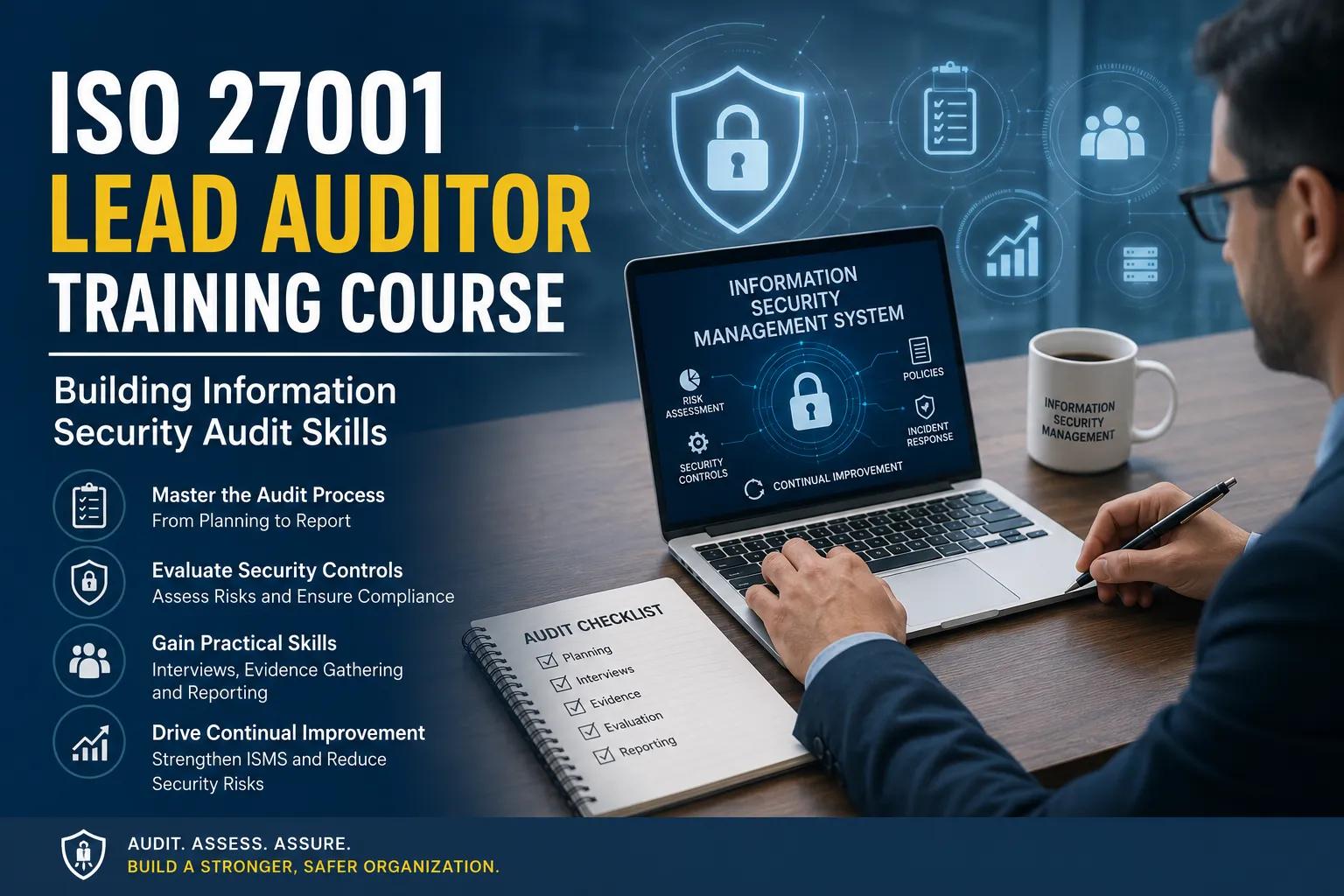
ISO 27001 Lead Auditor Training Course
Introduction
An ISO 27001 Lead Auditor Training Course helps professionals develop the knowledge and practical skills required to plan, conduct, report, and manage information security management system (ISMS) audits. ISO/IEC 27001:2022 is the internationally recognized standard for establishing, implementing, maintaining, and continually improving an ISMS. It applies to organizations of different sizes and sectors and focuses on managing information-security risks systematically.
As businesses increasingly depend on cloud platforms, remote work, artificial intelligence, digital payments, and connected systems, skilled information security auditors are becoming more important. Lead auditor training can help professionals understand how security controls and risk-management processes should be evaluated during an audit.
1. What Is an ISO 27001 Lead Auditor Training Course?
An ISO 27001 Lead Auditor Training Course is designed to teach participants how to lead audits against ISO/IEC 27001 requirements. Unlike basic awareness training, a lead auditor program focuses on the complete audit lifecycle, including audit planning, team management, evidence collection, reporting, and follow-up.
Participants typically learn how to establish audit objectives and scope, prepare audit plans and checklists, conduct opening and closing meetings, interview personnel, evaluate evidence, identify nonconformities, and prepare audit reports.
The training is particularly valuable for professionals involved in information security, quality management, IT governance, risk management, and compliance.
2. Key Skills Developed Through ISO 27001 Lead Auditor Training
A strong ISO 27001 Lead Auditor Training Course combines standard interpretation with practical auditing techniques. Important areas generally include:
Understanding ISO/IEC 27001:2022 requirements
ISMS scope and organizational context
Information-security risk assessment
Risk treatment and control selection
Audit planning and preparation
Evidence collection and evaluation
Interviewing and communication techniques
Nonconformity identification and classification
Corrective-action evaluation
Audit reporting and follow-up
Managing audit teams and audit activities
Professionals also learn to assess whether an organization's ISMS is functioning effectively rather than simply checking whether documents exist.
3. Why ISO 27001 Lead Auditor Skills Matter for Businesses
Information security is now a business-wide responsibility rather than an issue limited to IT departments. ISO explains that ISO/IEC 27001 uses a holistic approach covering people, policies, and technology while helping organizations manage cybersecurity risks and protect information confidentiality, integrity, and availability.
A competent lead auditor can therefore evaluate whether security practices are aligned with organizational risks and objectives. Effective auditing can help identify weaknesses, verify corrective actions, improve risk awareness, and support continual improvement.
The approach is also relevant to SMEs. ISO's practical guide for SMEs emphasizes that ISO/IEC 27001 can help smaller organizations establish an ISMS suited to their resources while improving resilience and customer confidence.
4. Latest ISO 27001 Trends and Cybersecurity Developments
The ISO 27001 Lead Auditor Training Course is increasingly relevant as organizations address evolving cybersecurity risks, cloud environments, supply-chain threats, privacy concerns, and artificial intelligence.
ISO/IEC 27001:2022 remains the current published edition, and it has a 2024 climate-action amendment. Organizations should therefore ensure that their ISMS considerations reflect applicable requirements and current organizational circumstances.
AI is another major area influencing information-security governance. Organizations using AI need to consider issues such as data protection, access control, information integrity, third-party risks, and responsible technology use. This is encouraging auditors to develop broader skills that connect traditional information-security controls with emerging digital risks.
5. Who Should Take an ISO 27001 Lead Auditor Course?
An ISO 27001 Lead Auditor Training Course can benefit information security managers, IT professionals, cybersecurity specialists, quality managers, internal auditors, risk and compliance professionals, consultants, and management-system auditors.
It can also support professionals seeking career opportunities in information-security auditing and certification. Candidates with previous knowledge of information security, ISO management systems, auditing, or organizational risk management may find the training easier to apply in practical situations.
When selecting a course, consider the training provider's credibility, trainer experience, course syllabus, practical audit exercises, examination structure, and whether the program aligns with your professional goals.
Conclusion
An ISO 27001 Lead Auditor Training Course provides valuable skills for professionals who want to lead effective ISMS audits and contribute to stronger information-security governance. With cyber risks becoming more complex and organizations increasingly adopting cloud services, AI, and digitally connected operations, the ability to evaluate information-security management systems is becoming increasingly important.
Learning ISO/IEC 27001:2022 requirements, risk-based auditing, evidence evaluation, nonconformity management, and audit leadership can help professionals contribute to resilient and continually improving information-security systems.